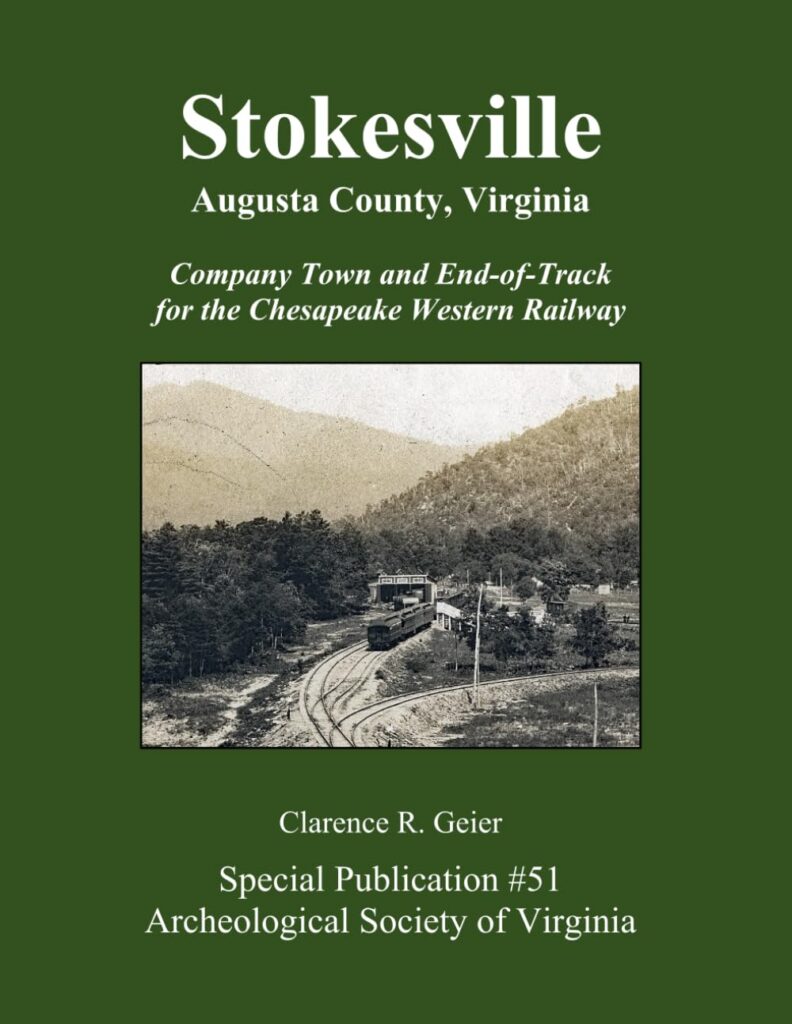
Stokesville, Augusta County, Virginia: Company Town and End-of-Track for the Chesapeake Western Railway Paperback – October 18, 2025 by Clarence R. Geier (Author)
Built at the onset of the 20th century, the town of Stokesville was founded, thrived and became lost to history in a period of roughly 13 years. Established in 1901, the history and productivity of the town was intertwined with the planning and construction of a local railroad identified as the Chesapeake Western Railway. The town became end-of-track for the railroad and was, in fact, a company town created to extract, process and ship the wealth of natural resources within the interior mountain landscape. Stokesville is one example of numerous short-lived communities established in the last half of the 19th century in the Appalachian and Blue Ridge Mountains of Virginia. It was towns such as this, often funded by northern capitalists, that contributed to a post-Civil War economic recovery of the Shenandoah Valley and western Virginia. While the discussed research is grounded in field archaeology, the manuscript includes discussions of: post-Civil War railroading in the Valley; the methods of laying track in the late 19th century; the economic impact of the CW Railway; the importance of coal to attracting financial backing for the Railway; the nature and importance of lumbering and the harvesting of tanbark; and the railroad, industrial, and residential features that were Stokesville. As the only known study of a company town of a type that provided economic prosperity to many areas of western Virginia, if only briefly, care is taken to interpret the available photo record and architecturally document the very small number of remaining, period structures that illustrate the intended ephemeral nature of the the company town.
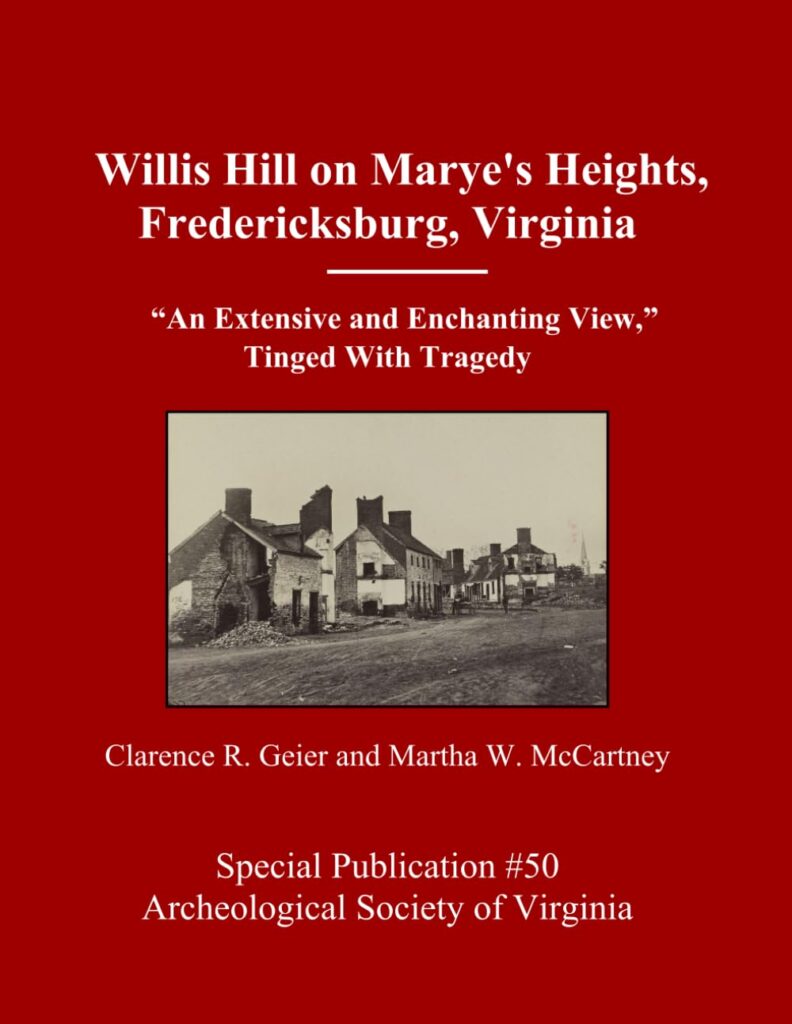
Willis Hills on Marye’s Heights, Fredericksburg, Virginia: “An Extensive and Enchanting View,” Tinged with Tragedy, Paperback – November 1, 2024 by Clarence R. Geier (Author), Martha W. McCartney (Author)
In 2000, the Fredericksburg Spotsylvania National Military Park funded a four-year program of archaeology, geology, and historic research on a rise of land known as Willis Hill, which is part of a lengthy escarpment known as Marye’s Heights. Although Willis Hill is best known for the role it played in the December 14, 1862, Battle of Fredericksburg, its earlier history also is significant. During the late 18th century, Willis Hill was the home of Henry Willis, one of Fredericksburg’s founders. During the years he and his family occupied their home on Willis Hill, Fredericksburg grew from a sparsely occupied settlement into a thriving market community and inland seaport. Thanks to this multidisciplinary project, the site of the Willis family’s domestic complex was identified as was the battery of the Washington Artillery of New Orleans. In addition, a more accurate restoration of the “Sunken Road,” an important military feature, was possible. This book is abundantly illustrated with historical maps and period photographs and contains excerpts from contemporary narratives.
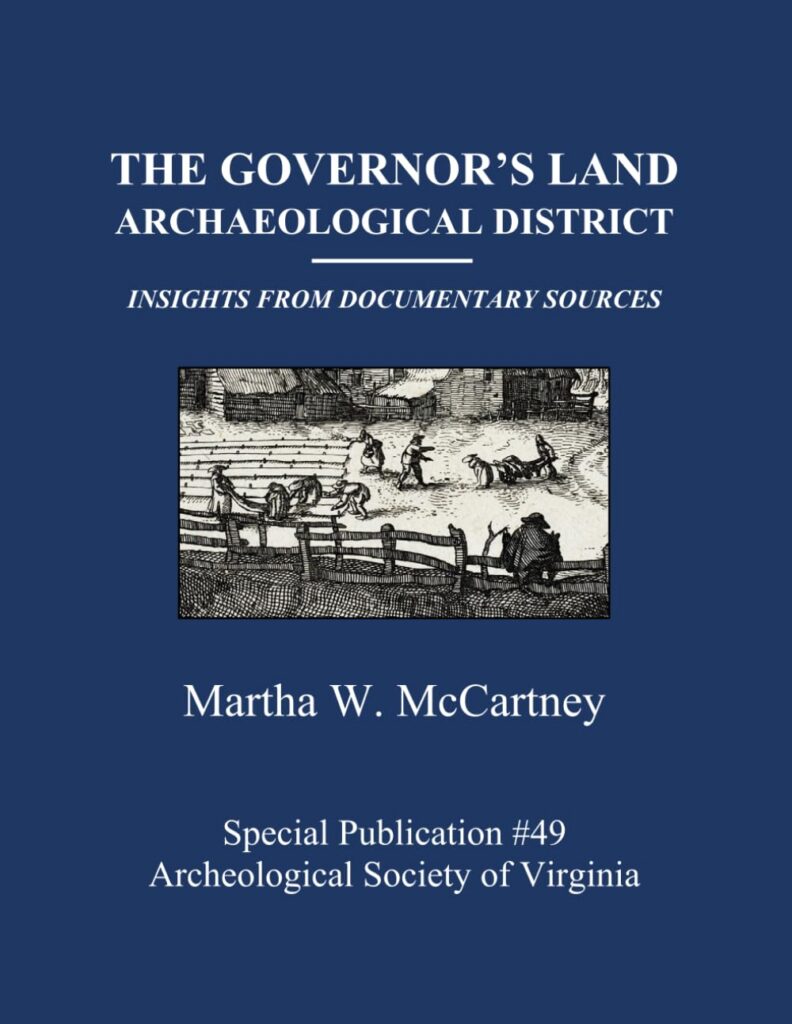
The Governor’s Land Archaeological District: Insights From Documentary Sources [McCartney, Martha W.]
In November 1618, the Virginia Company of London ordered Sir George Yeardley, its incoming governor, to set aside a 3,000-acre tract on the mainland. Although some archaeological sites on what came to be known as the “Governor’s Land” were professionally excavated during the early 1970s, another 50 years would pass before intensive documentary research explored its history. Most of James City County’s antebellum court records were lost or destroyed in 1865, but an abundance of other primary sources do far more than fill in the gaps. This information, distilled by skilled researcher Martha McCartney, significantly enhances our understanding of life on Jamestown Island and beyond.
Official records reveal that during the colony’s formative years, the Governor’s Land was a raucous place that was home to people from all walks of life: survivors of the 1622 Indian attacks, newly-arrived immigrants, indentured servants, jailbirds, adulterers, and hard-drinking men and women given to rowdy behavior. But there also were people simply trying to eke out a living while they recovered from a difficult transatlantic crossing.
Over time, as the agricultural economy evolved, these leaseholds were home to servants and enslaved people, and perhaps royalist refugees. They also were home to artisans, farmers, and ethnic minorities. Armed combat came to the Governor’s Land during Bacon’s Rebellion and more than a century later, the American Revolution left an indelible print on its cultural and physical landscape.
The Governor’s Land is on the Virginia Landmarks Register and the National Register of Historic Places, yet faces many threats. Approximately 700 acres has been lost to erosion and sea level rise. Moreover, Williamsburg suburbs have consumed massive amounts of acreage, destroying or disturbing the ephemeral sites once occupied by Native Americans and some of Virginia’s earliest European settlers. This book helps share some of the stories that might otherwise be lost.
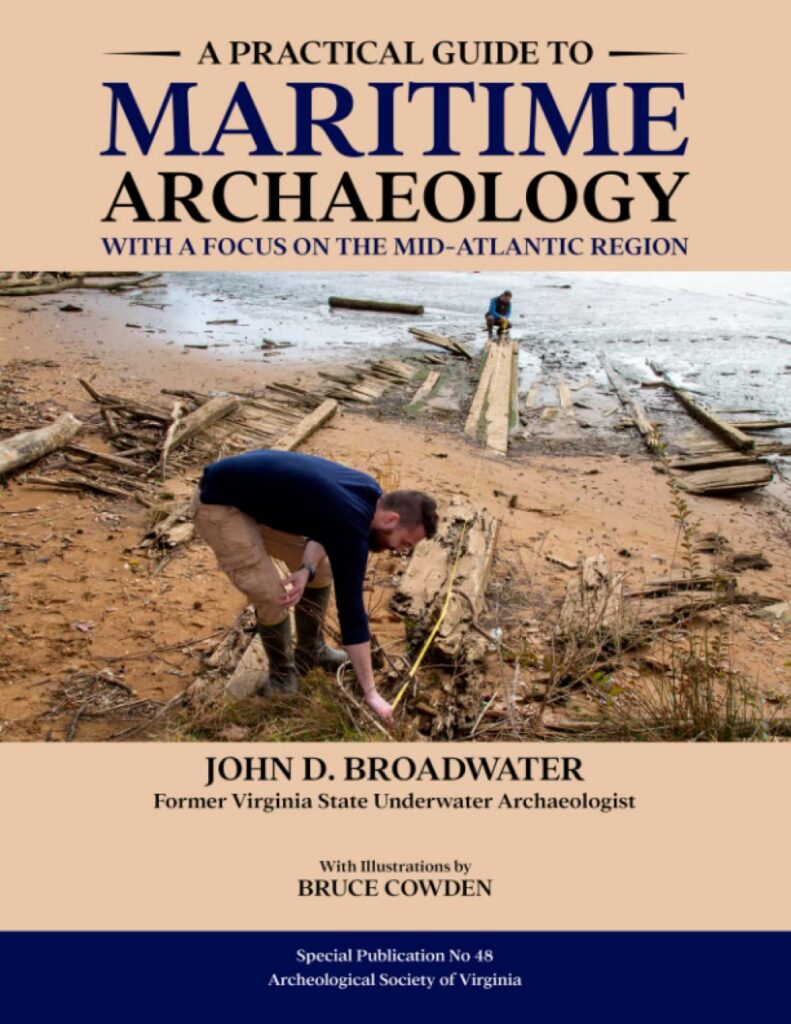
A Practical Guide to Maritime Archaeology: with a Focus on the Mid-Atlantic Region (Special Publicaton) Paperback – February 8, 2023 by Dr. John D. Broadwater (Author), Bruce Cowden (Illustrator)
Shipwrecks! Pirates! Sunken Treasure! The public never seems to get enough tales of swashbuckling sailors, their ships, and their adventures at sea. While many sea stories spring from the fertile imagination of fiction writers, many others—often rivaling or exceeding fictional accounts for excitement and adventure—are based on facts. Maritime historians and archaeologists scour archives, shorelines, and submerged lands in search of new details about our maritime past. This book introduces readers to the terminology, tools, and techniques used by maritime archaeologists in their quest for new sites that may add important details to the ever-expanding story of humans and their interaction with the seas, bays, and tributaries that link almost all the people of Earth. While the book focuses on New World sites, more specifically the Mid-Atlantic Region of the United States, much of the information is relevant to maritime research anywhere. The guide is essentially a textbook on maritime and underwater archaeology for nonprofessionals.
The book begins by describing the various terms relating to archaeology underwater, followed by descriptions of some of the most famous and significant shipwreck discoveries; the following chapters describe the types of maritime sites and provide a step-by-step description of how to develop a research plan, investigate an underwater archaeological site, and share research with others through publications, lectures, and social media. Excavation is not covered since that level of site disturbance should only be done by experienced professional archaeologists. Appendices provide suggestions for further reading, lists of agencies and organizations are involved in maritime archaeology, and detailed instruction and forms for conducting underwater research. The book is written in a conversational style, and the information is detailed, but easy to follow and understand.
The author, John Broadwater, has been conducting maritime archaeology projects for more than fifty years, much of it in the murky waters of the Mid-Atlantic where special methodologies are required to cope with the near-zero visibility. John was Virginia’s first State Underwater Archaeologist, directing a ten-year shipwreck project in the York River. John began diving in 1969 but had no knowledge of archaeological principles or techniques. He was fortunate to be offered opportunities to work with professional maritime archaeologists, but he still values his connections to recreational divers and avocational archaeologists, so he has devoted a great deal of time and effort providing opportunities for those groups to learn about and participate in his research. He was a founder of the Archeological Society of Virginia’s Maritime Heritage Chapter. This book is Broadwater’s most recent effort to promote educational training and opportunities for divers and avocational archaeologists.
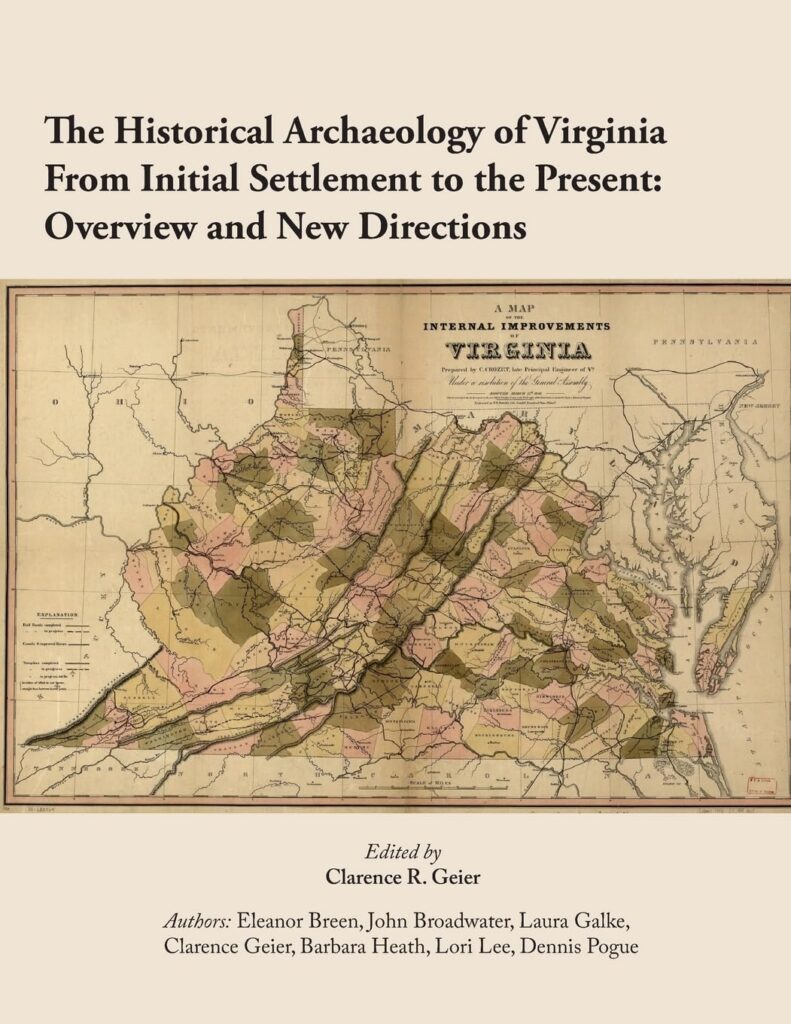
The Historical Archaeology of Virginia From Initial Settlement to the Present. $25
Edited by Clarence R. Geier. Chapters cover Virginia history from initial settlement through the 20th century, plus one which deals with the important role of underwater archaeology. Written by prominent archaeologists with research experience in their respective topic areas, the chapters consider important issues of Virginia history and consider how the discipline of historic archaeology has addressed – and needs to address — them. Changes in research strategy over time are discussed, and recommendations are made concerning the need to recognize the diverse and often differing roles and impacts that characterized the different regions of Virginia over the course of its historic past. Significant issues in Virginia history needing greater study are identified.
A Field Guide for Virginia Archaeology (and the Middle Atlantic Region, in General): A Practical Guide to a Dirty Business. $15
Michael B. Barber provides guidelines and instructions on conducting archaeological fieldwork. Written with humor, the author tells you not only how to do the work of archaeology but also why the work needs to be done a certain way. Includes forms that can be reproduced for your own use and a list of recommended readings.
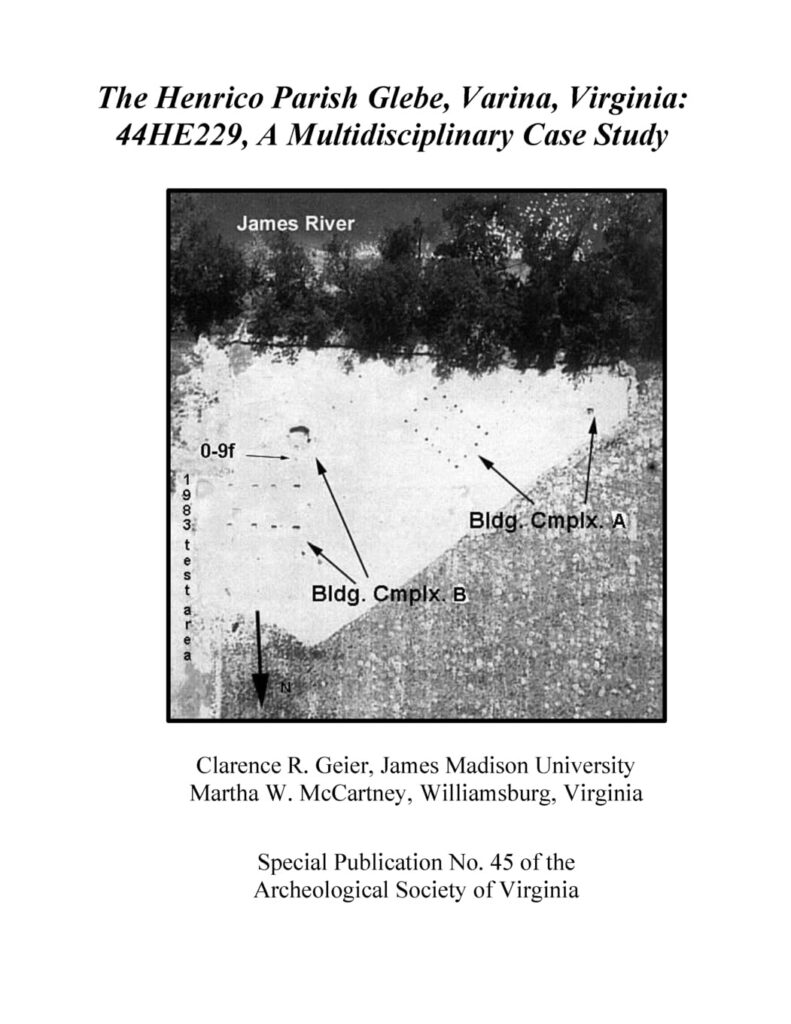
The Henrico Parish Glebe, Varina, Virginia: 44HE229, A Multidisciplinary Case Study $15.
By Clarence R. Geier and Martha W. McCartney. This book introduces the reader to the historical and archaeological evidence of a significant Colonial Period habitation on the James River believed to have been seriously impacted by 17th and 18th century floods and hurricanes. The interpretation of the Henrico Glebe Site, located within Henrico Parish Glebe lands at Varina, opens the door to a discussion of the role of the Church of England in the Virginia Colony and the types of housing parish leaders were obliged to provide to the clergy. Included is a rigorous discussion of Virginia legislation and parish records, as well as a physical description of the diverse residences and service buildings based on archeological findings. Paperback.
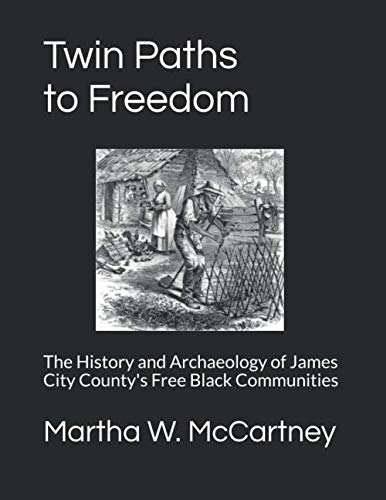
Twin Paths to Freedom: The History and Archaeology of James City County’s Free Black Communities. $15
By Martha McCartney. During the first half of the nineteenth century, there were two Free Black settlements in James City County, Virginia: one that was purposefully established, and another whose formation was happenstance. These two communities’ origins and their inhabitants’ personal histories provide unique insights into the life experience of Virginia’s Free Blacks. Among the issues discussed are household composition, employment, living conditions, material culture, family stability, and social mobility. A succinct overview of the laws that governed Africans’ and African Americans’ everyday lives serves as a backdrop for the main narrative. The research of social historians, archaeologists, architectural historians, and experts in the field of material culture is used to recreate the world in which nineteenth century Free Blacks lived.
